
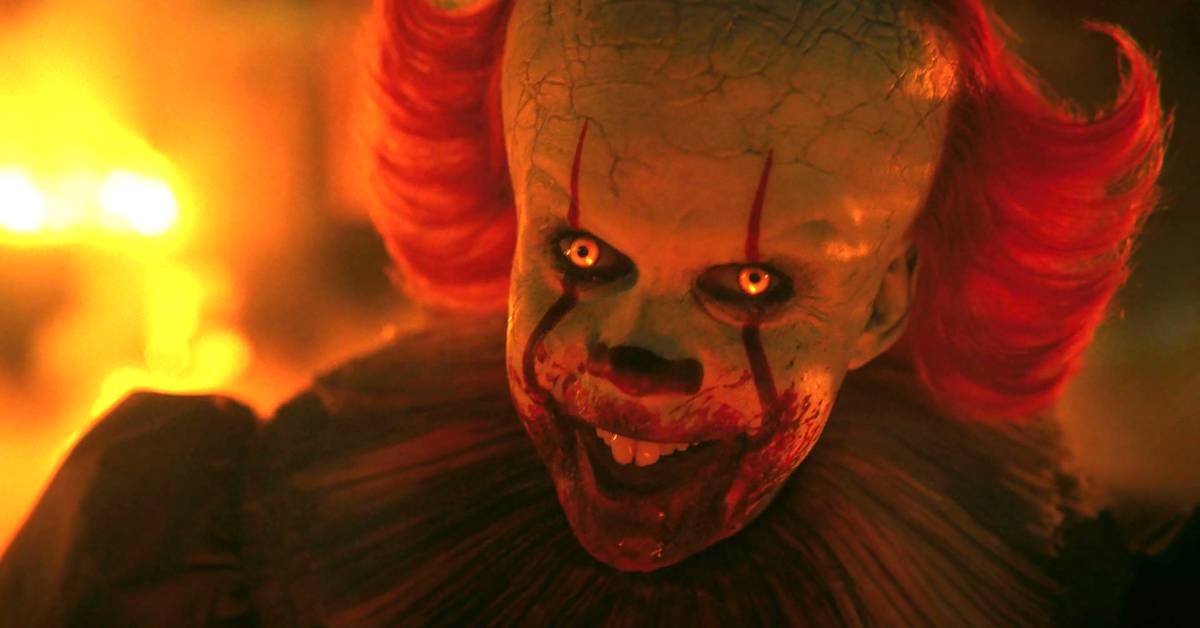
Bill Skarsgård isn’t done with Pennywise yet. While IT: Welcome to Derry season 1 ended with the monstrous clown’s apparent defeat, the actor is already teasing a deeper, more layered return for future seasons—if HBO gives the green light.
Set decades before Andy Muschietti’s IT and IT Chapter Two, Welcome to Derry reintroduced Skarsgård’s Pennywise in a chilling new context. The prequel series, co-created by Andy and Barbara Muschietti with Jason Fuchs as co-showrunner, shifts the action to 1962 and follows a fresh group of kids who discover Derry’s dark, cyclical horror. Along the way, the show doesn’t just bring Pennywise back to terrorize new victims; it also cracks open the door on his true origins.
One of the most intriguing pieces of that origin storytelling comes from the Bob Gray persona. In an interview with ScreenRant while promoting his crime biopic Dead Man’s Wire, Skarsgård dove into the sequence set in 1908, where he plays Bob Gray before IT fully claims the clown’s form. This isn’t the swaggering “Eater of Worlds” we’ve seen before, but a broken, washed-up performer that Skarsgård describes as “this kind of drunk, has-been clown.”
In that flashback, Bob Gray interacts with IT as a childlike entity, and Skarsgård revealed that the scene was one of the most creatively fertile moments they shot. He and the creative team improvised heavily, discovering unexpected nuances in Bob’s personality and his dynamic with the cosmic horror that would become Pennywise. He contrasted that moment with the more theatrical, over-the-top scenes—like the unsettling “Oh my darling, I love you” exchange with his daughter—which makes Bob feel like more than just a vessel; he feels like a tragic character in his own right.
Skarsgård admitted that those discoveries hinted at hidden depths to the character and teased that “we might see more of him in the future.” For fans, that’s a strong signal that future seasons of IT: Welcome to Derry may continue exploring the fractured psyche and layered identity of Bob Gray and Pennywise, rather than only focusing on IT as a purely inhuman monster.
The season 1 finale sets up that expansion in a big way. In a twist-heavy ending, Pennywise pulls Matilda Lawler’s Marge aside during the group’s desperate attempt to restore the cage keeping him bound to Derry. There, he reveals one of the most important pieces of mythology in the series so far: IT experiences time nonlinearly. Past, present, and future exist simultaneously for him.
This revelation reframes everything. Pennywise isn’t just a creature that feeds every 27 years—he’s a being who can see every feeding cycle, every failure, and every defeat all at once. For Marge and Lilly, that’s a terrifying prospect. Even in the moment of his apparent defeat, they’re forced to consider what it means if Pennywise can use his time-bending awareness to potentially rewrite events or take steps to avoid the circumstances that ultimately destroy him in IT Chapter Two. He may also be capable of altering the futures of the very people who challenge him.
From a storytelling standpoint, this twist is a gift. It allows Welcome to Derry to continue moving backward through Derry’s history while still feeling connected to the overarching IT narrative fans already know. The creative team’s roadmap reflects this: season 2 is planned to take place in 1935, centering on the infamous Bradley Gang massacre, while season 3 would take viewers back again to 1908, the same era that features Bob Gray’s tragic fall and his fateful encounter with IT.
Season 1 already laid down a key piece of lore by revealing exactly when IT chose the Pennywise persona, giving fans a concrete point in the timeline. Future seasons could show how this form evolved from a desperate, fading clown into the sewer-dwelling predator who taunts children as the confident “Eater of Worlds.” That evolution is precisely where Skarsgård sees opportunity—he’s clearly interested in playing Pennywise not just as a monster, but as a complex entity with conflicting layers, memories, and possibly even regrets traced back to Bob Gray.
On paper, everything looks primed for more Welcome to Derry: a built-in multi-season arc, a fan-favorite villain with untapped backstory, and a lead actor enthusiastic about deepening the role. The only roadblock is the one thing fans can’t control: the business side.
Despite a strong reception, HBO has not yet officially renewed IT: Welcome to Derry for season 2. That hesitation doesn’t appear to be about ratings. The series launched with the third-biggest debut in HBO Max history, behind only House of the Dragon and The Last of Us—elite company for any genre show. The season 1 finale became its most-watched episode, showing that audiences stuck with it. Critics and viewers were almost perfectly aligned, too, with Rotten Tomatoes scores in the low 80s from both camps.
Instead, the uncertainty seems to come from the larger corporate shake-ups surrounding Warner Bros. Discovery. With HBO, HBO Max, and other WB assets caught up in a potential sale to Netflix—while Paramount and Skydance aggressively pursue their own competing bid via legal and financial maneuvering—many series are stuck in limbo. Studios are waiting to see which way the wind blows before committing to expensive, effects-heavy genre shows.
Yet if any series has a strong case to survive the turbulence, it’s IT: Welcome to Derry. It’s part of a globally recognized horror franchise, it already has a multi-season outline built around Derry’s cyclical tragedies, and it features one of modern horror’s most iconic performances in Bill Skarsgård’s Pennywise. Add in the clear appetite from audiences and critics, and it’s easy to imagine whichever company ends up in control viewing Welcome to Derry as a valuable anchor for its genre slate.
For fans, the most enticing prospect is the continued exploration of Pennywise’s psychology and history. Seeing how Bob Gray’s weaknesses, vices, and human failings bleed into the cosmic entity’s persona could redefine how we think about Pennywise in the films. Was IT simply exploiting a broken man’s image, or did it absorb pieces of Bob Gray’s identity in the process? Is that why Pennywise so often acts like a performer seeking an audience, delivering kill scenes like twisted stage acts? Future seasons, especially one set fully in 1908, are perfectly positioned to answer those questions.
Whether we get to see that potential realized rests on renewal. Skarsgård is game. The creative team has a clear, backward-moving timeline designed to weave through Derry’s most notorious tragedies. Fans are eager to learn more about Pennywise’s time-shifting awareness, his “birth,” and the subtle changes in how his deaths and defeats manifest across the timeline.
The ball is now in HBO and its eventual corporate parent’s court. If the series does return, expect deeper dives into Pennywise’s fractured existence, more answers about Bob Gray’s true role in the mythos, and a richer, more terrifying look at Derry’s cursed history.
For now, all eyes remain on the renewal decision—and on how far Skarsgård and the Welcome to Derry team will be allowed to push Pennywise into new, more layered territory.
Stay tuned to BlueBoxNERD to get the latest from nerd culture.